Data visualizations
Selected Work
 View full-size figure
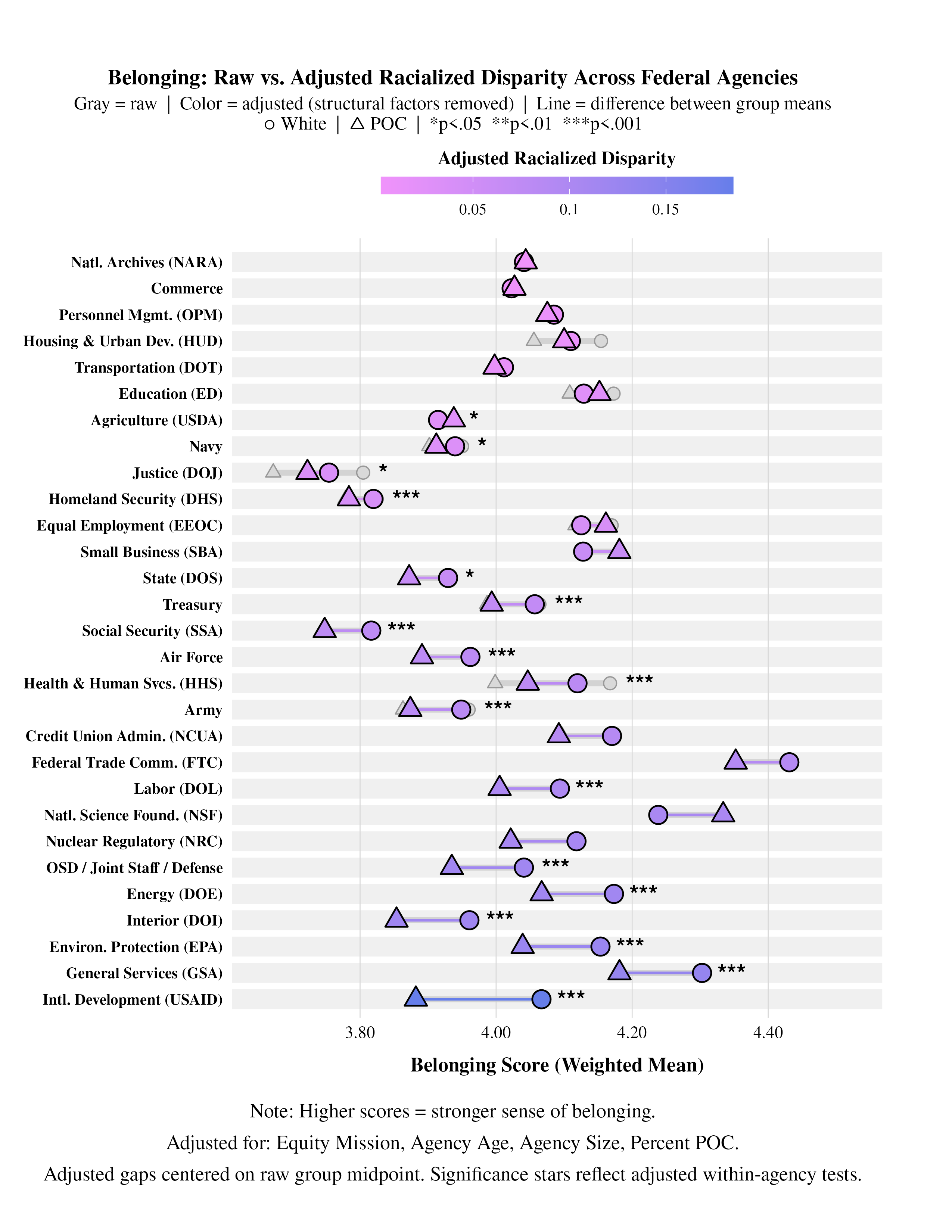
Organizational Belonging Across Federal Agencies
Figure description
Adjusted White–POC disparities in organizational belonging across 29 federal agencies, after accounting for agency-level structural predictors (equity mission, agency age, agency size, and percent POC). Gray bars show the raw gap; colored bars show the gap after adjustment. Agencies are ranked by adjusted disparity magnitude.
Key finding
Across 29 federal agencies, the majority of agencies structurally disadvantage employees of color in organizational belonging compared to their White counterparts. These disparities persist even after accounting for agency-level structural characteristics, suggesting that racialized organizational processes shape belonging outcomes beyond what agency mission and size explain, even when workforce composition is taken into account.
 View full-size figure
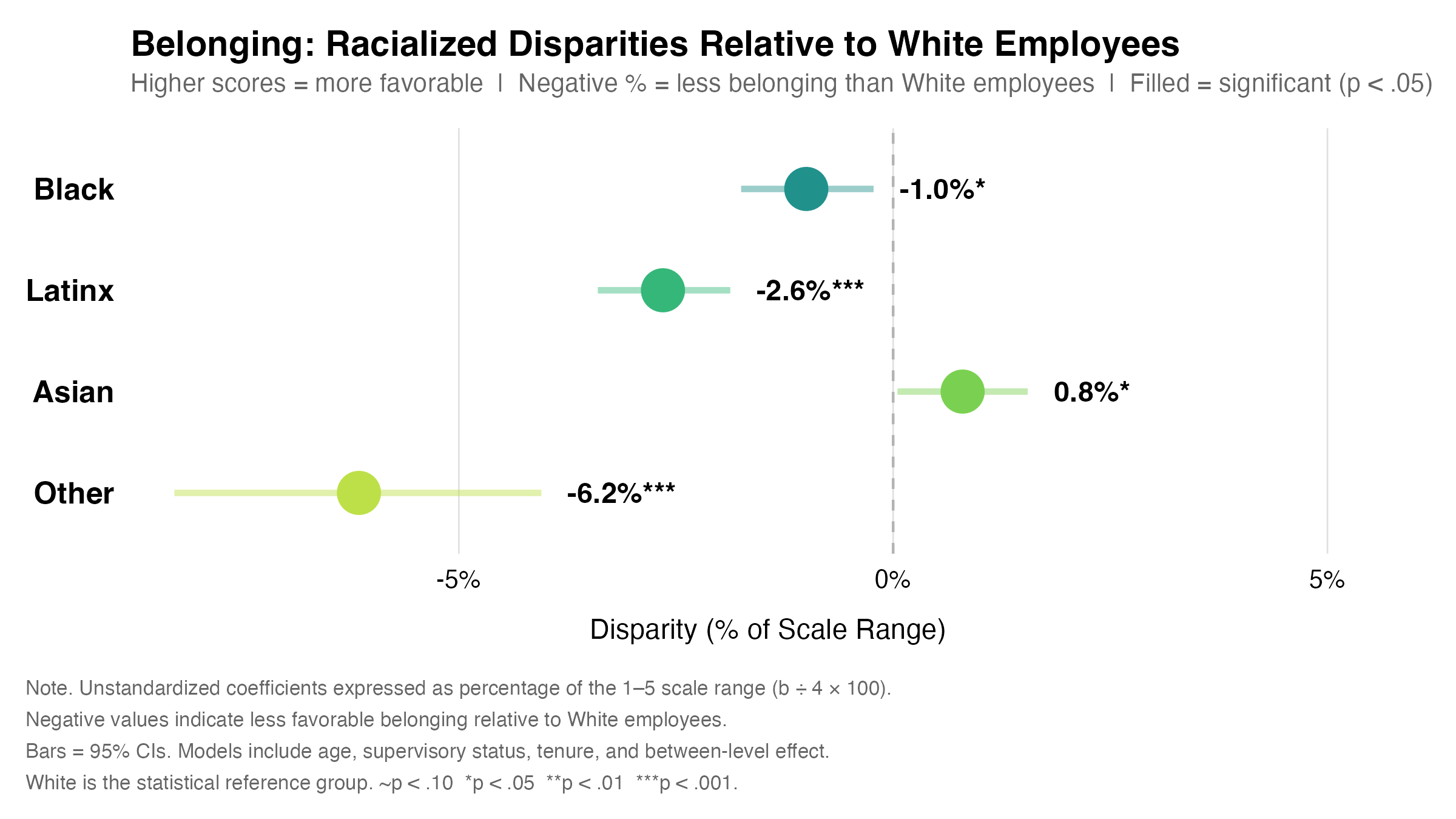
Racialized Disparities in Organizational Belonging
Figure description
Racialized disparities in organizational belonging for Latinx, Black, Asian, and Other-race employees relative to White federal employees. Negative percentages indicate less favorable belonging. Estimates are unstandardized coefficients expressed as a percentage of the 1–5 scale range, with 95% confidence intervals.
Key finding
Black employees report significantly less organizational belonging than White employees. This also holds for Latinx and Other-race employees, reflecting structural conditions that limit access to inclusion for these groups. Asian employees, by contrast, report more favorable belonging conditions relative to White employees. These patterns point to how racialized organizations distribute the experience of inclusion unevenly across racial groups.
 View full-size figure
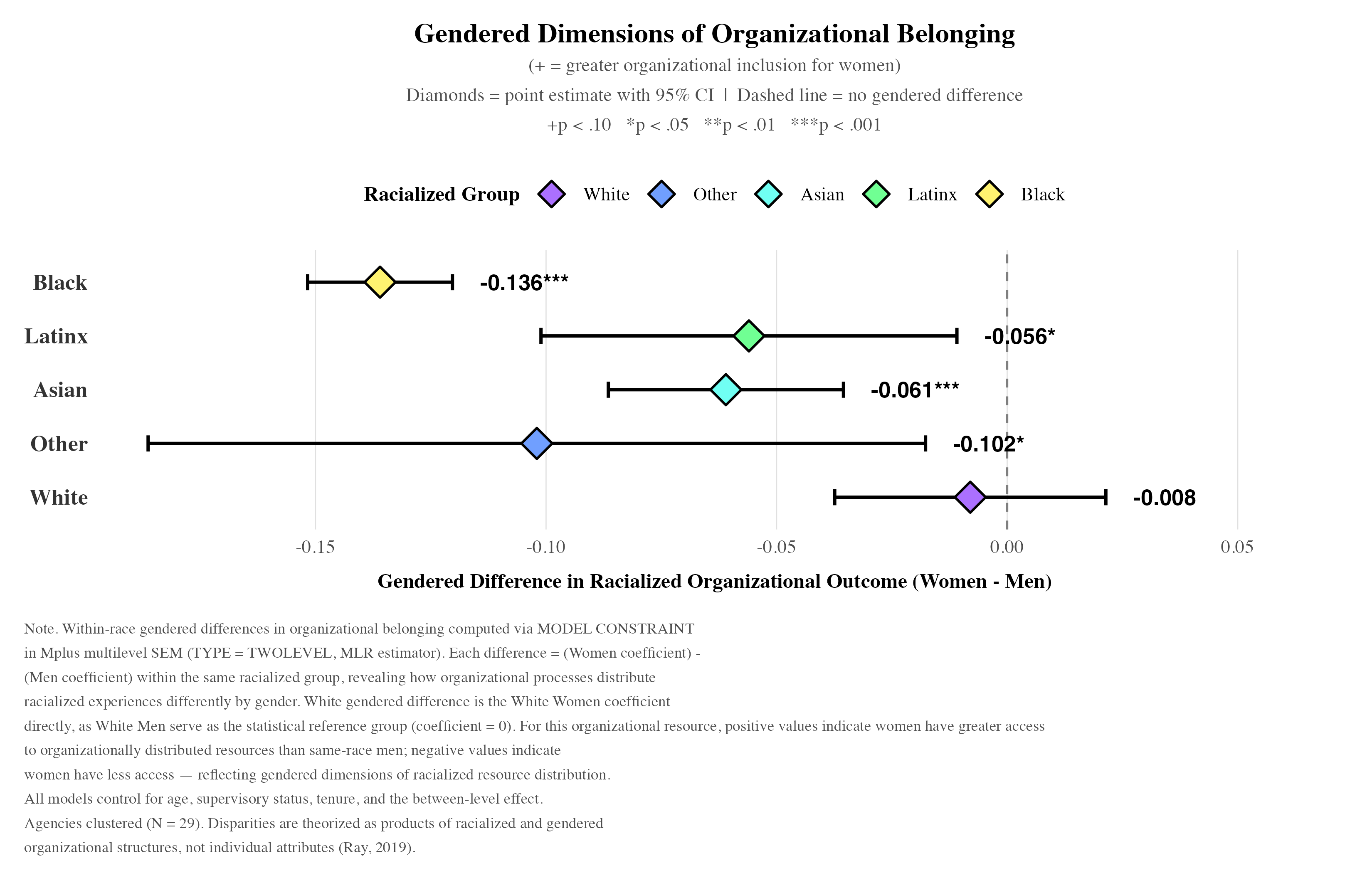
Gendered Dimensions of Organizational Belonging
Figure description
Within-race gender differences in organizational belonging (Women − Men) across five racial/ethnic groups. Positive values indicate women report greater belonging than same-race men; negative values indicate less. Diamonds represent point estimates with 95% confidence intervals from multilevel SEM models.
Key finding
Statistically significant gender differences in belonging emerge within Black, Latinx, Asian, and Other-race groups, with women in each group reporting less belonging than their male counterparts. No such difference exists between White men and White women. This pattern suggests that gendered organizational processes operate within racialized structures, compounding disadvantage for women of color while leaving the belonging of White employees relatively undifferentiated by gender.